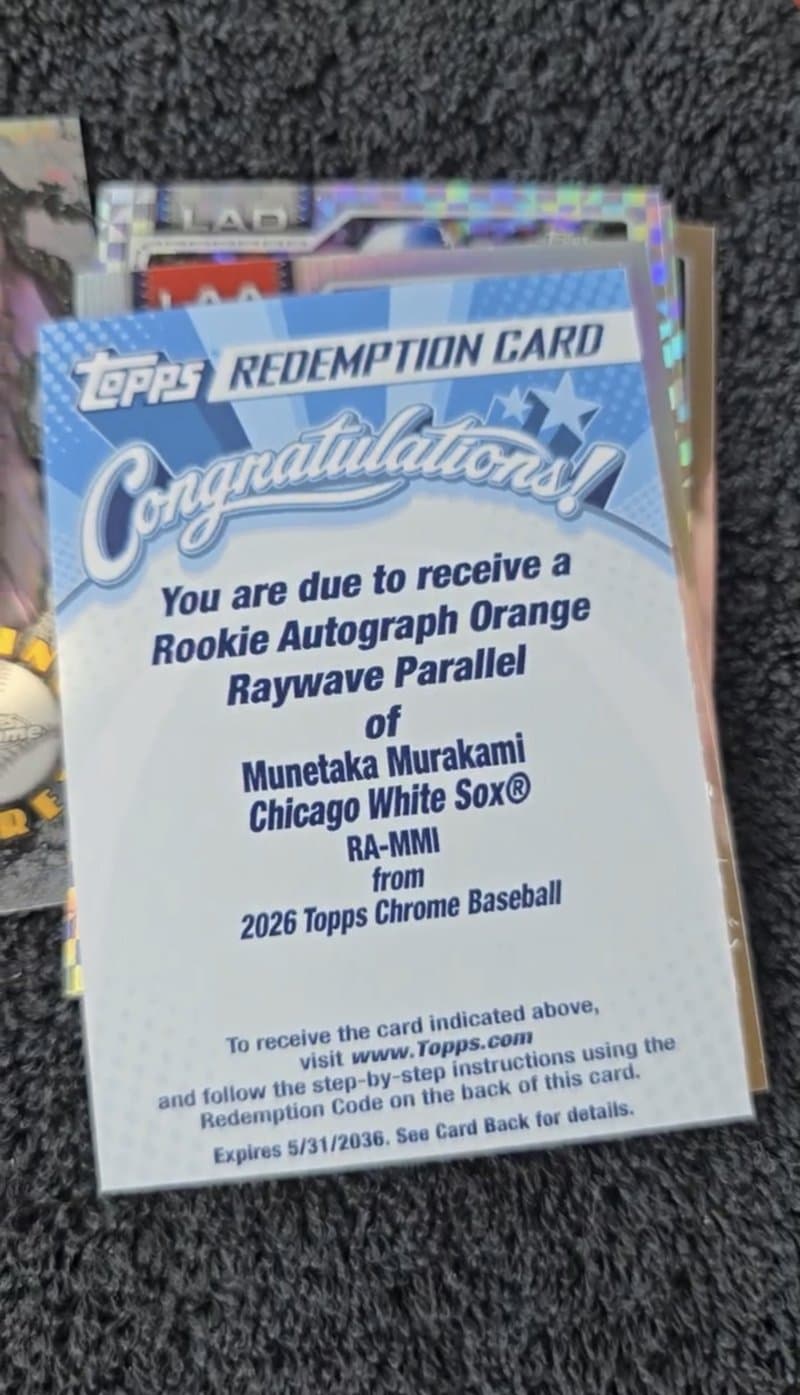
I'm a few packs into a hobby box, thumbing past base cards and a parallel or two, when the next card stops me. There's no player photo, no autograph, no foil. Just a big “Congratulations!” across the top and a few lines of text telling me which autograph I'm due to receive. My first thought is that something went wrong at the factory. It didn't. I just pulled the hit in IOU form.
That's a redemption card. The first time you pull one, it may be overwhelming. Here's what it is, why it exists, how to cash it in, how the market treats them, and every option you have for what to do with yours.
What a redemption card is
A redemption card is a placeholder for a card that wasn't ready when the product was packed. It's almost always an autograph. The front tells you exactly which card you're owed. The back has a scratch-off code you use to claim it from the manufacturer.
Think of it like a rain check at the grocery store. The sale item is out of stock, so the store hands you a slip that guarantees the deal when the next shipment arrives. You still get the item. You just get it later.
Why card companies use them
Print schedules don't wait for athletes. A set like Topps Chrome is printed, packed, and shipped on a fixed date. Autographs get signed on the player's schedule, which runs around games, travel, and the offseason. When a player hasn't returned signed cards by the deadline, the company can pull the card from the set or put a redemption in the pack. Most choose the redemption.
Late signatures
The most common reason. The player hasn't signed yet, which happens a lot with in-season rookies.
Late additions
A player is added to the checklist after production starts, so the card physically doesn't exist yet.
Production problems
Autographs that fail quality control, or multi-signer cards still waiting on one signature. A dual auto is only as fast as its slowest signer.
Collectors don't love redemptions, and the companies know it. Topps said back in 2008 that its top priority was eliminating them. They're still around because the alternative is shipping a product with holes in the checklist. If you're wondering where a redemption sits in the pecking order of pulls, our guide to case hits and rarity tiers covers it. A redemption carries the same value as the card it stands in for.
How to redeem a Topps redemption card
1. Scratch off the code gently
The code is under a silver scratch-off on the back. Use a fingernail, not a key. If the code can't be read, you'll have to mail the card in, and an unreadable code can void it.
2. Log in to Topps.com and open Redemptions
Sign in to your Topps account (or create one), go to Redemptions, and confirm your shipping address. If you've ever ordered a Topps NOW card, you already have an account.
3. Enter the code and submit
The redemption then shows up in your Open Orders tab.
4. Wait for it to ship
Topps currently asks for 15 weeks. Your account shows the status as Processing until the card goes out, then Shipped.
Before you scratch
Photograph both sides. Once before scratching and once after. If anything goes wrong, Topps support asks for the code.
Check the expiration date. It's printed on the front. Expired codes are void. The one pictured above runs to 2036, but don't assume yours does. Older products often have much shorter windows.
Keep the physical card until the real one is in your hands.
Know the fallback. If Topps can't deliver the card, it can send a substitute card or Topps.com credit. If the card arrives damaged or wrong, file a Product Defect Submission with Topps support and type REDEMPTION as the order number.
Panini and Upper Deck work the same way. Panini redemptions are entered through your account at paniniamerica.net. If the card isn't available, Panini lets you wait up to six months or take a substitute. Upper Deck uses a similar code system. Whatever the brand, follow the instructions printed on the back of your card.
The market for redemption cards
Redemptions have their own secondary market. Unredeemed cards sell on eBay every day, and the buyer enters the code themselves. Some collectors sell right away so they don't have to wait. Others buy redemptions on purpose because they usually trade below the finished card. The buyer is getting paid to wait and to take on the risk that the player never signs or Topps sends a substitute.
Prices follow the player, just like the finished card would. A redemption for a rookie having a big season gets more expensive while it sits in a drawer. We saw that play out with Murakami in The Murakami Effect. To see what one is really worth, check sold listings, not asking prices. Our card valuation guide walks through how.
If you're buying
Buy unscratched only, and make sure the photos show the scratch-off still intact. A scratched code may already be used, and a used redemption is just cardboard. Some sellers openly list used ones, so read the full description, not just the title. Check the expiration date, check seller feedback, and pay through eBay so you have buyer protection.
If you're selling
Don't scratch it. Photograph the front and back with the scratch-off untouched, show the expiration date, and say clearly in the title that the card is unredeemed.
Shop and price redemption cards on eBay
- Unredeemed Topps redemptions for sale →
- Recently sold Topps Chrome redemptions →
- Sold 2026 Topps Chrome Murakami rookie autos →
Affiliate links — Dugout Vault may earn a commission at no cost to you.
Your options with a redemption card
Decide before you scratch. Once the code is entered into your account, the physical card can't be sold as a working redemption, so selling it unredeemed is off the table.
1. Redeem it and keep the card
The simplest path, and the right one if you collect the player or the set. Follow the steps above and wait it out. The only cost is time.
2. Sell it unredeemed
Cash now and no waiting. The buyer takes on the wait and the risk, so expect less than the finished card sells for. Leave the scratch-off untouched and follow the seller tips above.
3. Redeem it, then sell the finished card
Usually the most money, because you sell at the full finished-card price instead of the redemption discount. You can also have it graded first if it's worth it; our grading guide helps you decide. The trade-off is the wait. The player's price can rise or fall while the card is in the mail. Compare sold prices for the redemption and the finished card before you choose between this and option 2.
4. If the card can't be filled
Sometimes the card never gets made, usually because the player stops signing. Topps may offer a substitute card or Topps.com credit instead. Panini lets you wait up to six months or take a substitute. A substitute isn't always worth what the original would have been, so check sold prices on what's offered before you accept, and contact the company's support if the offer doesn't look fair.
Keep reading
Reader Pulls
Pulled something big? Send it in.
Chris's redemption gave us this post. Send photos of your best hits or ideas for what we should cover next. Email allen@dugoutvault.app or tag @dugoutvault on Instagram or @Dugout_Vault on X.
Subscribe Free →A redemption card feels like a letdown when it falls out of the pack. It isn't. It's the same hit with a delay attached. Scratch carefully, enter the code, and hang on to the card until the real one shows up.
Same hit. Longer wait.